Posts

Showing posts with the label bra science

Are You Overfitting Your Wires? A look at breast root anatomy
Image
Bra making has taken a very modular turn in the past few years: to make a well fitting bra, you must: Take a root trace (while leaning forwards) Match this to a wire chart and order some similar wires Make a fitting band to fit your wire and band Add the cups and fit those This system works well for some, but there are some pitfalls that are very easy to get muddled in when approaching bra making like this. Beginners especially can sometimes be lost in endless alterations, a lack of lift, and perpetually uncomfortable bras. These issues stem largely from the ideas that: The best fitting wire is one that matches your root width perfectly The wire must fit close to perfectly for the bra to fit well A perfectly taken root trace (again, taken leaning forwards) will show your breast root perfectly The fit of the wire can - and should - be determined without adding the cups, to avoid tissue being pushed out by too small cups  The cups can then be easily altered to fit with this new f...

Bra Physics Part 3: What can we learn about the wires and cradle?

Image
This is Part 3 of my Bra Physics series. In Part 1 , I described the forces involved in supporting your breasts and what parts of a bra are responsible for providing those forces. In Part 2 I introduced the concepts of stress and strain, and applied these and part 1's principles to the design and fit of bands. Now let's move on to the much maligned underwire (and the cradle). In the original Bra Physics post , I didn't talk much about the role of the underwire. The wires are a critical part of the "foundation" of a wired bra, as improper design or fit can cause pain and even injury, as well as reduce the support available in a bra. The underwire's main job is to resist the forces of the band, maintaining a cupped shape despite the bra being under high degrees of tension. Because the underwire is being pulled on by the band, we need to recap the stress and strain concepts discussed in Part 2 . Recap: Stress and Strain The strain of an item is essentially...

Necklines always cutting in? Why full cups may be your foes and power bars your unlikely friends

Image
I have a series of posts about the physics behind supportive bras . In the first post, I described that the band should make up most of the support system of a bra - but this doesn't mean the straps are not important. The best way to boil that post down is that the band provides support to the breasts but the straps maintain the shape of the cups by providing a key anchor point for the upper part of the cups. This post could be considered an additional part of that series, and for that reason an extended edition can be found on my Ko-fi . Don't worry, the main Bra Physics series hasn't been abandoned - I just wanted to get this one out first. The straps transmit a vertical tension force into your bra cup, and changing exactly where those forces travel can have major fit implications. This force transmission is very important in larger cup sizes where a bra is designed to be more supportive, so the ideas in this post will apply to a lesser degree for small or medium cup siz...

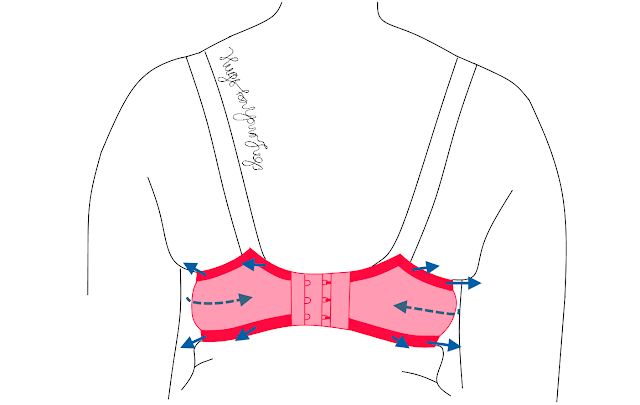
Bra Physics Part 2: What Can We Learn about the Band?

Image
In my last bra physics post , I described the forces involved in supporting your breasts and what parts of a bra are responsible for providing those forces. How can this knowledge inform our decisions when making or choosing bras? This post is part of a series and covers the bands of bras - just the stretchy part. The cradle (which surrounds the wires) will be discussed later.   As before, an e x t e n d e d v e r s i o n o f t h i s p o s t c a n b e f o u n d o n m y Ko-fi , w h e r e y o u c a n g e t i n s t a n t a c c e s s t o t h i s a n d p r e v i o u s e x t e n d e d b l o g p o s t s f o r j u s t £ 2 . I f y o u w a n t , y o u c a n become a member for £2 a month t o continue s u p p o r ting m y b l o g .  

The Physics of a Supportive Bra Explained

Image
An extended version of this post can be found on my Ko-fi , where you can get instant access to this and previous extended blog posts for just £2. If you want, you can become a member for £2 a month to continue supporting my blog. To all boob owners reading this: I would like you to take off the clothes on your upper half and stand in front of a mirror. I would buy you dinner first, but unfortunately on my student budget I can't afford to wine and dine all of my readers, so you'll just have to take a chance on me.  If your body shape and ability allows, I would like you to use your hands to support and mould your boob into the ideal shape you would like them to be in a supportive bra. Usually, people are looking for a bra to give them the following sort of profile: Side profiles of some unsupported and supported breasts If you've gone and moulded your boobs, I'll wager you have done something like I did to achieve that look.

You're probably not Omega, just Projected - here's the difference, and how it affects bra patterns

Image
In the online bra making community omega is a popular term, and many people (esp. in larger cup sizes) consider themselves to have an omega breast shape. Omega is a term that popular instructor Beverly Johnson claims to have coined, and she explains what she means by it in this post . Her definition (and conceptualisation) of omega has been adopted by the community as a whole, however I have always had an issue with it: in my opinion, omega conflates two different breast shapes, leading to confusion amongst bra makers.    One of these shapes is omega, but both require an Omega Adjustment?

The Surprisingly Common Phenomenon of Sizing Up for Depth

Image
Back when I was 14 and just learning about how bras should really fit, I measured myself at home by /r/ABraThatFits ' guide at a 26FF, then was fitted by a friendly in-store fitter into a 28G/26GG . I remember thinking during the fitting that the Cleo Maddie fit very well, and left the store happy in my Bravissimo Satine - having just come from a 32D!  But then as the weeks progressed, I became confused. The bras I was trying in 28G - and even 28FF - were... too big. For my next bra, I settled in a Freya Piper Plunge Balcony in 28FF, my breast tissue sinking to the bottom, convinced I was very full on bottom because why else would these bras have so much space at the top? I had unknowingly become a victim of "sizing up for depth", and it took me years to actually figure out what had happened - and that I actually have tall roots that make me functionally full on top.

The Gender Pay Gap in British lingerie - why, and what are companies going to do about it?

This is a follow-up post to my previous post "The Gender Pay Gap - how do large British lingerie companies compare? ". Now that we know that these companies do have gender wage gaps, let's see what they had to say about them. All of the companies gave some explanation, and most of them stated how they planned to fix it. But will these plans have any effect? Are they ambitious enough? How will we know as consumers if these plans are working and to what extent? Let's dive into it, company by company, as I paraphrase all of the reports (publicly available on the Gender Pay Gap Service ). Warning: this post is super long so if you just want an overview, scroll to the end. I will probably end up publishing an abridged ranking at some point in the future if this is just too many words to read (understandable).

The Gender Pay Gap - how do large British lingerie companies compare?

Image
What is the gender pay gap? "The gender pay gap is the difference in the average hourly wage of all men and women across a workforce. If women do more of the less well paid jobs within an organisation than men, the gender pay gap is usually bigger. The gender pay gap is not the same as unequal pay which is paying men and women differently for performing the same (or similar) work. Unequal pay has been unlawful since 1970" - Gender Pay Gap Service Due to recent legislation, all employers with 250 or more employees must calculate and publish (among other things), their mean and median gender pay gaps. This has recently come into effect with April 2018 being the first time private companies have been forced to publish this data. I have taken the opportunity to go through the reports of lingerie companies and compare them by category so you can find out what these gender pay gaps are, how they compare across companies, and what each individual company has to say about it. ...

Rib Cages and Bra Fitting - a Masterpost

Image
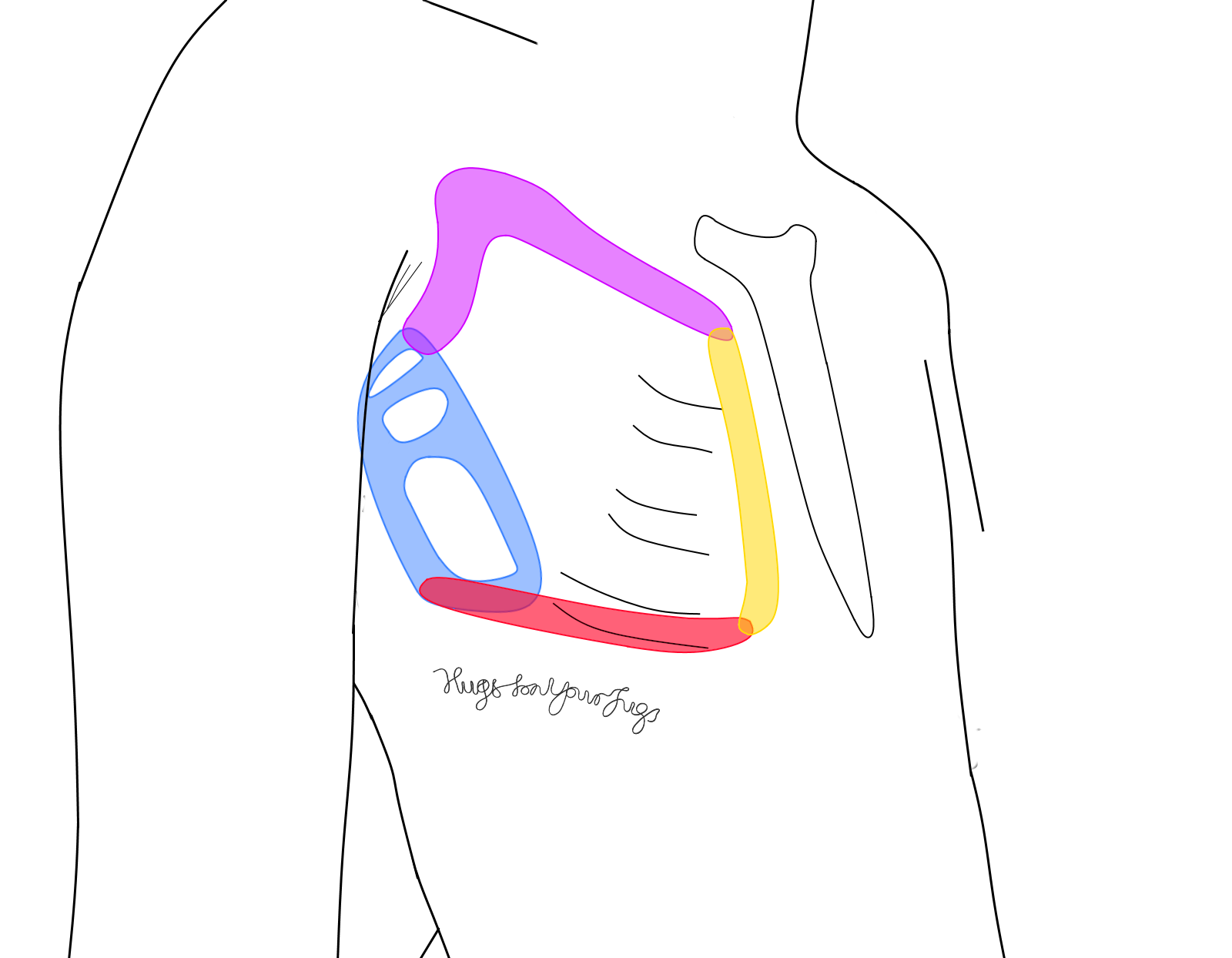
I've realised that while there are titbits (pun intended) of information about how rib Cages can affect bra fit floating around, it's never been collated into one easy to access article. So I've tried to do that: most of the information in this post is credited to other hardworking bloggers, please check out the credits at the end to support their work! Also big thanks to my sister for the lovely diagrams. 1. Rib Cage Shapes (horizontally) There are two basic types of rib cross-sections to consider in relation to bra fitting, disregarding the sternum (we'll get onto the breastbone later): Flat vs Barrel Shaped Ribs   Flat ribs (left) - the most common rib cage shape   Barrel shaped ribs (right) - more rounded than the average rib cage shape Most bras are designed to fit best on flat ribs.

The Outwards Scoop

Image
We all know that it's important to scoop all tissue  from the outside of the bra *into* the cups, as well as positioning the wires correctly , but recently I have been thinking about an extension of the manoeuvre: The Outwards Scoop You may be thinking that this is just a way to make a too small cup look like it fits correctly , but I promise you it's more than that. What is the purpose of the scoop and swoop? To make sure that all tissue that was outside the wires is now inside the wires - of course, provided that the bra isn't too narrow overall. For those with soft tissue (and particuarly those with pendulous breasts and loose skin as well), or just a very projected shape simply scooping the traditional way can force tissue into the gore space *past* the root of your breast. This causes tissue to sit under the gore, either pushing it away or having the gore sit on breast tissue - not ideal!

Bra Science: How Band Size Changes with Cup Size - Freya

Image
Welcome to part two of my series on how band lengths are not always equal between cup sizes. Last time we had Cleo by Panache , now we're testing Freya's band lengths. I collected Bratabase data on the stretched and unstretched band lengths in a couple of band sizes of Freya bras - the ones with the most data. The results are as follows:

Bra Science - 16 Signs You're Wearing a Parachute Bra

Image
Since people loved my 11 Signs You're Wearing a Boob Hat  post, I have decided to write one about the opposite syndrome: The Parachute Bra. Parachute bras are worn by people who have realised that the "plus 4" method of measuring people is a terrible system, but they go too far the other way - wearing too small bands and too large cups to compensate. I call them parachute bras because the cups billow in the wind, and the band is tight around you like a harness. Some people call this "reverse letterphobia" but I've chosen a different name because I feel that reverse letterphobia is a little bit.. judgey (and my name is catchier ngl). Why do people do this? They may be very afraid of the too loose bands they were wearing in the past, they may want to be a smaller band and larger cup than they are because of a lack of body confidence, or they may just not quite know how a bra should fit. They may also have a projected shape and size up to get the depth the...